By Armadillo Metal Roofing | Austin’s Commercial Metal Roofing Specialists
Your commercial roof is one of the most expensive systems in your building, and the advice you act on determines whether a repair holds for 20 years or fails in two. Bad roofing guidance is everywhere, and it rarely announces itself as bad.
Direct Answer
Bad commercial roofing advice typically comes from contractors who lead with price, skip the diagnostic phase, or recommend repairs when replacement is the honest answer. Credible guidance includes a documented inspection, a clear explanation of what’s failing and why, realistic timelines, and a written scope of work before any money changes hands. If you’re not getting all four, you’re not getting real guidance.
Key Takeaways
- A contractor who quotes a price before inspecting the roof is guessing, not advising
- The cheapest bid almost always reflects a shorter scope, not better efficiency
- Insurance claim assistance is a service your contractor should offer, not something you figure out alone
- Restoration and replacement are not interchangeable options, and the wrong choice costs significantly more over time
- Credible contractors welcome questions about their process; evasive answers are a disqualifying signal
Why Does Bad Roofing Advice Spread So Easily?
Most commercial property owners and facility managers aren’t roofing experts. That’s not a criticism. It’s the structural reason bad advice circulates without friction.
When you don’t know what a proper inspection looks like, a confident contractor who skips one doesn’t seem negligent. They seem efficient. When you’ve never seen a detailed scope of work, a one-page quote feels like a complete proposal. The gap between what credible guidance looks like and what most people expect is wide enough for a lot of bad contractors to operate comfortably inside it.
The most confident pitch is often the least trustworthy signal. Contractors who lead with certainty before they’ve inspected anything are selling, not advising. Real expertise tends to come with questions, not just answers.
This is a mid-funnel problem. You’re not looking for a roofing primer. You’re trying to figure out whether the advice in front of you is worth acting on. That’s the right question to be asking.
What Are the Actual Warning Signs?
Here are seven patterns that should stop you before you sign anything.
- A price quote before a roof inspection
This is the clearest signal. A contractor who quotes you a number over the phone or after a five-minute walkthrough isn’t working from information. They’re working from a sales script. A real assessment requires getting on the roof, documenting what’s failing, and explaining the mechanism of failure, not just the symptom.
- They recommend the same solution to every problem
Some contractors only do full replacements. Others only do coatings. If the recommendation matches their inventory before it matches your roof condition, that’s a conflict of interest, not expertise. The right answer depends on what’s actually happening with your roof.
- No written scope of work
Verbal agreements in commercial roofing are how disputes start. A credible contractor provides a written scope that specifies materials, methods, drainage considerations, and what happens if additional damage is found. If they resist putting it in writing, that tells you something.
- They can’t explain why the damage happened
Surface-level advice treats symptoms. A contractor who patches a leak without explaining what caused it is setting you up for the same repair in 18 months. Root cause identification is not optional on a commercial roof. It’s the whole job.
- No mention of your insurance options
A significant portion of commercial roof damage qualifies for insurance coverage, particularly after hail, wind events, or the kind of severe weather Austin sees regularly. If your contractor doesn’t bring this up, they’re either unaware of the process or not set up to help you with it. Either way, you’re leaving money on the table.
- Pressure to decide immediately
Urgency tactics are a sales mechanism, not a roofing reality. Genuine emergencies require immediate action, and a trustworthy contractor will explain exactly why. Artificial urgency, where you’re told a price expires or a crew is only available today, is a pressure tactic designed to prevent you from getting a second opinion.
- No track record in commercial metal roofing specifically
Residential roofing and commercial metal roofing are different trades. The materials, drainage systems, load considerations, and failure modes are not the same. A contractor with strong residential experience but limited commercial metal work is not the right fit for a flat-seam standing metal roof or a large commercial installation.
If any of these patterns showed up in a recent conversation with a contractor, it’s worth getting a second assessment before committing. Armadillo Metal Roofing offers straightforward evaluations with no pressure attached. Contact us to schedule yours.
What Does Credible Roofing Guidance Actually Look Like?
The Credible Guidance Standard is a four-part baseline that separates professional advice from sales activity. It’s not complicated, but most contractors don’t meet all four criteria.
Credible Guidance Standard is: a documented inspection, a root cause explanation, a written scope, and realistic outcome framing before any contract is signed.
Here’s what each part means in practice.
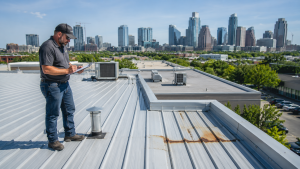
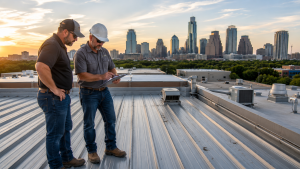
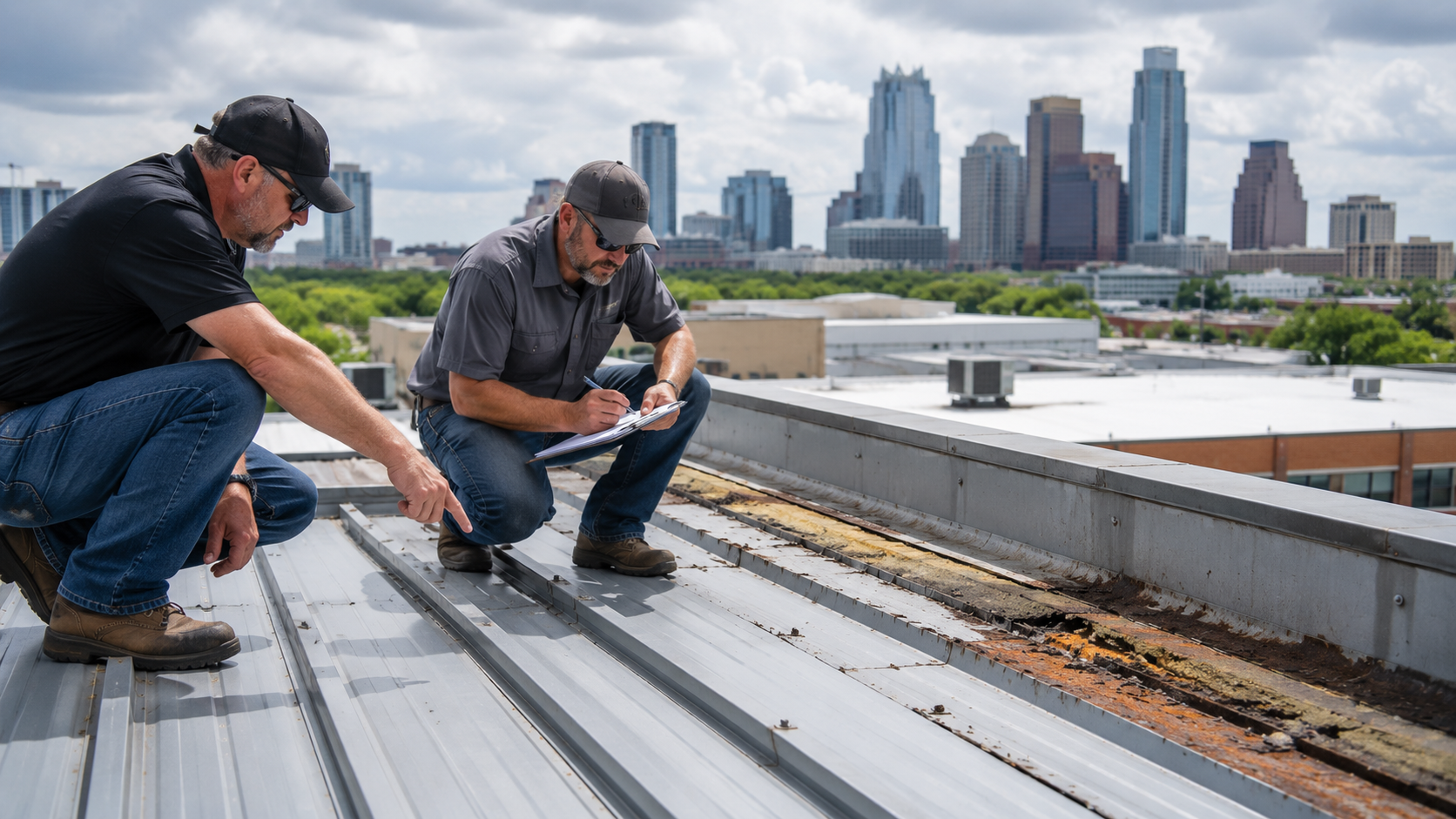
Documented inspection. The contractor gets on the roof, photographs the damage, and provides a written condition report. You should be able to read it and understand what’s failing and where.
Root cause explanation. Not just “you have a leak” but why the leak is happening. Is it a failed seam? A drainage issue? Fastener corrosion? The cause determines the correct repair.
Written scope. Every material, every method, every exclusion. If something isn’t in the scope, it’s not in the contract.
Realistic outcome framing. A credible contractor tells you what a repair will and won’t do. If a restoration will extend the roof’s life by 10 to 15 years but won’t address a structural drainage problem, you need to know that before you pay for it.
Consider a typical scenario: a facility manager in Round Rock gets three quotes after a hail event. Two contractors recommend full replacement. One recommends a restoration coating. Without a documented inspection report from each, there’s no way to evaluate which recommendation is honest. The one who provides the inspection report with photographs and a written explanation of the damage is the only one offering real guidance. The other two are guessing, or worse, upselling.
Restoration vs. Replacement: Why Getting This Wrong Is Expensive
This is where bad advice does the most financial damage.
Restoration is the process of cleaning, repairing, and coating an existing metal roof to extend its service life without full tear-off. Replacement is removing the existing system entirely and installing new material.
Restoration is the right call when the substrate is structurally sound, the damage is surface-level or limited to specific areas, and the roof has meaningful remaining service life. It typically costs significantly less than replacement and can be completed faster with less business disruption.
Replacement is the right call when the substrate is compromised, when restoration has already been done and the roof has reached the end of its viable life, or when damage is widespread enough that repair costs approach replacement costs.
The error that costs property owners the most is replacing a roof that could have been restored, or restoring a roof that needed replacement. Both mistakes come from skipping the diagnostic step.
| Situation | Right Call | Wrong Call |
| Isolated seam failures, sound substrate | Targeted repair or restoration | Full replacement |
| Widespread substrate corrosion | Replacement | Surface coating |
| Post-hail damage with intact structure | Insurance claim plus restoration | Paying out of pocket without filing |
| Roof past service life, multiple failed repairs | Replacement | Another patch repair |
| New construction or major expansion | New installation with proper spec | Repurposing incompatible materials |
Armadillo Metal Roofing assesses every roof before recommending a path. The goal is to give you the honest answer, not the most profitable one.
Who This Approach Doesn’t Fit
Straight talk: if you’re managing a small residential property with a minor repair need, a commercial metal roofing specialist isn’t your most efficient call. The Credible Guidance Standard applies most directly when the stakes are high, meaning larger commercial properties, significant storm damage, insurance claims, or any situation where the wrong decision has a multi-year financial consequence.
The more square footage involved, the more complex the drainage system, and the higher the insurance exposure, the more the quality of the advice matters. A bad recommendation on a 500-square-foot residential repair is inconvenient. The same quality of advice on a 20,000-square-foot commercial roof is a serious financial problem.
Waiting to get a professional assessment because you’re not sure the damage is “bad enough” is the most common version of this mistake. Damage that looks minor from the ground is often more extensive at the substrate level. The cost of finding out is much lower than the cost of finding out too late.
FAQ
How do I know if my commercial roof damage qualifies for an insurance claim?
Most commercial roof damage from hail, wind, or severe weather qualifies for an insurance claim, but the documentation has to support it. A contractor experienced in insurance claim assistance can inspect the roof, document the damage in the format insurers require, and help you file correctly. Filing without proper documentation is one of the most common reasons legitimate claims get underpaid or denied.
What’s the difference between a roof restoration and a roof coating?
A coating is a single product applied to a surface. A restoration is a full process that includes cleaning, mechanical repairs to failed seams or fasteners, and then application of a coating system. Restoration addresses underlying issues first. A coating applied over unrepaired damage will fail at the point of the original damage, often faster than the original material did.
How long does a commercial metal roof restoration typically last?
A properly executed restoration on a structurally sound substrate can extend roof life by 10 to 15 years in most cases, though actual results depend on the condition of the existing system, the quality of materials used, and how well drainage issues are addressed. No honest contractor can guarantee a specific number without a documented inspection first.
Why do I keep getting different recommendations from different contractors?
Different recommendations usually mean different contractors are looking at different things, or have different financial incentives. A contractor who only does replacements will find reasons to replace. A contractor who only does coatings will find reasons to coat. The way to cut through this is to ask each contractor to document their inspection findings in writing and explain specifically why their recommendation fits the documented condition.
Is it worth getting a second opinion on a commercial roof assessment?
Yes, particularly when the recommended scope is large or the costs are significant. A second opinion on a major commercial roof project is standard practice, not an insult to the first contractor. Any contractor who discourages a second opinion is telling you something important about their confidence in their own assessment.
What should I ask a contractor before signing anything?
Ask them to walk you through the inspection report and explain the root cause of the damage. Ask for a written scope that includes materials and methods. Ask whether the damage may qualify for an insurance claim. Ask what the repair won’t fix, meaning what limitations or exclusions apply. A contractor who answers all of these clearly and in writing is worth working with.
How quickly can emergency commercial roof repairs be done in Austin?
Response time depends on the contractor, but 24/7 availability matters when active weather damage is creating ongoing water intrusion. Armadillo Metal Roofing offers emergency repair response because waiting until business hours when water is entering a building isn’t a realistic option for most commercial operators. Temporary stabilization can usually be completed quickly; permanent repair follows after full assessment.
Your roof is one of the few building systems where bad advice compounds. A wrong repair doesn’t just fail. It delays the right repair, masks ongoing damage, and often voids warranty coverage on the correct work that follows. The time to apply the Credible Guidance Standard is before you sign, not after.
Armadillo Metal Roofing has been working with commercial property owners across the Austin area for 20 years. Mark and the team provide direct oversight on every project, and we’re available around the clock when the situation calls for it. If you’ve got a roof that needs an honest assessment, call us or request an estimate online. We’ll tell you what we find, not what’s easiest to sell.
About the Author
Armadillo Metal Roofing is a commercial metal roofing specialist serving Austin, TX and the surrounding area, with 20 years of experience in repair, restoration, replacement, and new installation. They work with facility managers, commercial property owners, and project managers to deliver professional roofing solutions with direct owner involvement, 24/7 emergency availability, and honest assessments from inspection through project completion.