Your roof isn’t failing because of one bad storm. It’s failing because of a pattern of decisions made before the storm ever arrived.
Commercial property owners and facility managers in Austin face a specific kind of pressure: maintain operations, control costs, and avoid surprises. The problem is that roofing decisions made under that pressure tend to create exactly the surprises they were meant to prevent.
Key Takeaways
- Delaying inspection after visible roof damage is the single most expensive decision a facility manager makes, because minor repairs compound into full replacement territory faster than most budgets account for
- Insurance claims on commercial metal roofs require documentation that starts before you call your carrier, not after
- The cheapest bid rarely reflects the actual scope of work needed on a commercial metal roof
- Waiting until interior damage appears means the roof membrane has already been compromised for months
- Armadillo Metal Roofing provides 24/7 emergency response, insurance claim support, and instant online estimates for commercial properties across the Greater Austin area
The direct answer, for anyone who needs it up front:
The most common mistakes commercial property owners make with metal roofing come down to three patterns: acting on visible symptoms rather than structural causes, treating roofing as a reactive expense rather than a managed asset, and underestimating what unqualified or rushed work costs them long-term. Each mistake is correctable, but only before the damage compounds.
What’s Really Going Wrong When a Commercial Roof “Just Fails”?
The surface story is always the same: a storm rolls through Austin, water shows up inside, and suddenly there’s a crisis. But the roof didn’t fail during that storm. It failed months or years earlier, when small warning signs got logged as “monitor” items and never escalated.
This is the core problem. Commercial roof failure isn’t an event. It’s a process.
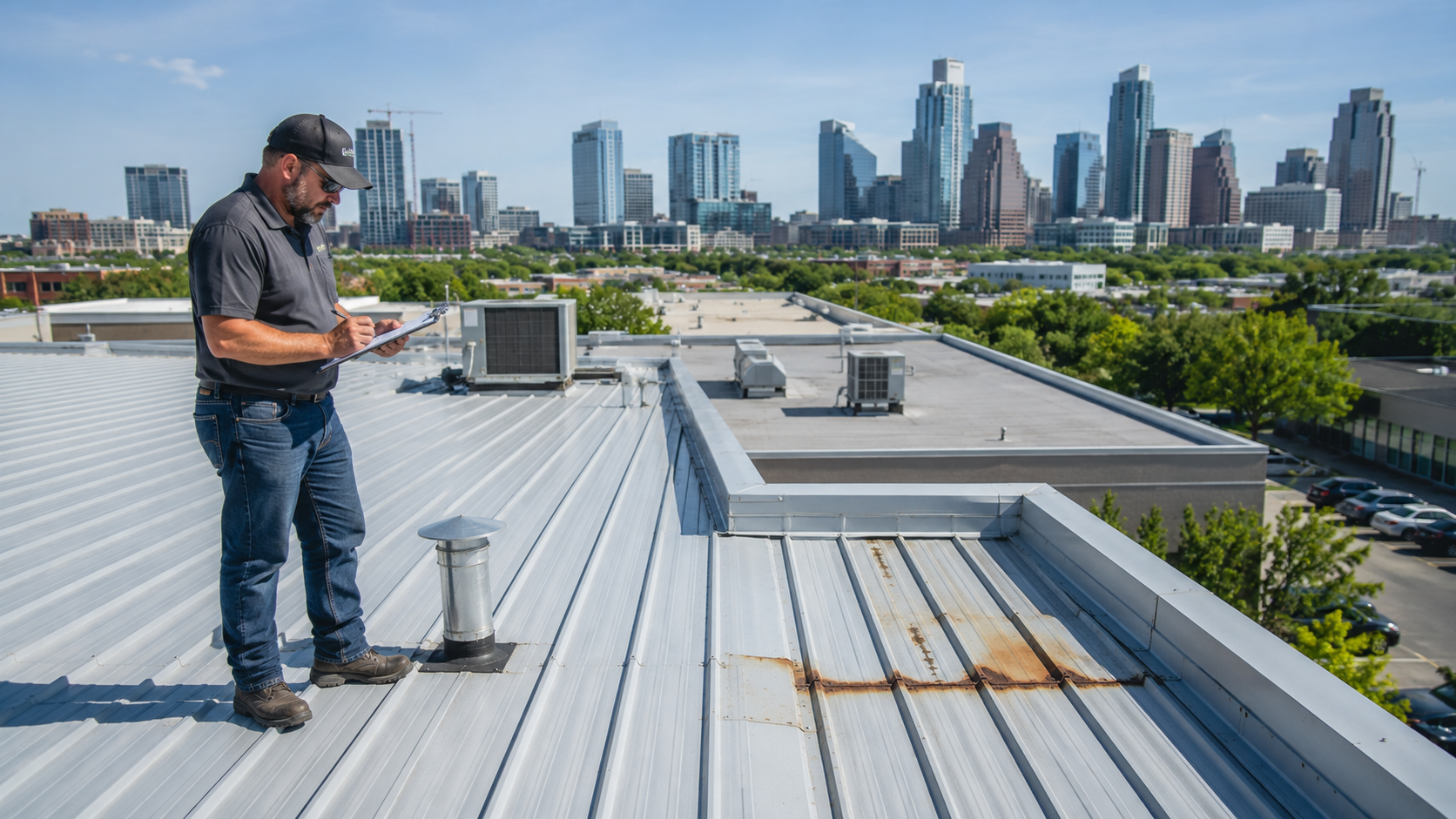
The most expensive roofing decision you’ll ever make is the one you postponed. A small flashing separation or sealant failure costs a few hundred dollars to fix. Left alone through one Texas summer of thermal expansion and contraction, it becomes a substrate issue. Left alone through two summers, you’re looking at decking replacement.
The mechanism here matters. Metal roofs expand and contract with temperature changes, and Austin’s climate is brutal in this regard. When a small breach exists, that movement works like a pump, pulling moisture in during the cool of night and pushing it deeper during the heat of the day. By the time water appears on your ceiling tiles, that process has been running for a long time.
A common scenario: a facility manager at a mid-size Austin warehouse notices a slight discoloration on an interior wall panel after a heavy spring rain. It dries out, nothing else happens, and it gets noted but not acted on. Six months later, after a summer of 100-degree days, a routine inspection finds compromised insulation across a 400-square-foot section of roof deck. What would have been a $600 repair is now a $12,000 restoration project.
Why Do Smart Facility Managers Keep Making These Calls?
The answer isn’t carelessness. It’s a structural problem in how roofing decisions get made inside commercial organizations.
Roof maintenance competes for budget against items with immediate, visible ROI. A new HVAC unit is easy to justify. A preventive roof inspection is harder to defend in a budget meeting when the roof isn’t actively leaking. The result is that roofing gets funded reactively, which is the most expensive way to fund it.
There’s also a procurement pattern that consistently produces bad outcomes: selecting contractors based on lowest bid without understanding scope differences. Two bids for “commercial roof repair” can describe entirely different scopes of work. One contractor is patching surface symptoms. Another is addressing the underlying substrate condition. The bids look comparable on paper. The outcomes are completely different.
Unqualified work doesn’t just fail to solve the problem. It often masks it long enough for the damage to deepen before anyone realizes the repair didn’t hold.
The Inspection-First Framework: A Decision Tool for Austin Facility Managers
The Inspection-First Framework is a sequencing rule for commercial roofing decisions: no scope, no budget, no contractor selection should happen before a qualified inspection has defined what’s actually there.
Use it when:
- Any visible roof damage has occurred, regardless of severity
- You’re preparing an insurance claim
- You’re evaluating a repair vs. restoration vs. replacement decision
- You’ve received bids that differ significantly in price
Don’t rely on it when you’re already in an active emergency, where temporary stabilization comes first. In that case, call for emergency service immediately, then run the framework once the situation is stabilized.
The framework has three gates:
- Inspection defines scope. Not assumptions, not the last contractor’s assessment from two years ago.
- Scope defines options. Repair, restoration, or replacement are not interchangeable. Each applies to a specific condition range.
- Options define budget. Budget conversations that happen before scope is defined almost always result in underfunding the actual work needed.
This sequence sounds obvious. It’s violated constantly, because budget conversations happen first in most organizations, which forces scope to fit the budget rather than the other way around.
If you’re currently sitting with a repair quote and you haven’t had an independent inspection first, that’s the right next step. Armadillo Metal Roofing offers instant online estimates and on-site assessments for commercial properties across the Austin area, with direct involvement from ownership on every project.
What Does Getting This Right Actually Look Like?
Realistic outcomes, without the sales language:
A commercial property owner who catches a metal roof issue early, gets a proper inspection, and works with a qualified contractor is typically looking at repair costs that are a fraction of what a delayed response would require. Restoration, when it’s the right call, can extend a roof’s service life significantly without the disruption and cost of full replacement.
Insurance claims are a separate category where the documentation process matters as much as the damage itself. Claims that are filed with thorough pre-claim inspection documentation, clear photo evidence, and a contractor who understands the insurance process move faster and settle more accurately than claims filed without that groundwork.
Consider a typical case: a commercial property in Round Rock sustains hail damage after a severe storm. The owner calls their insurance carrier first, then looks for a contractor. By the time a contractor is involved, the documentation window for optimal claim support has narrowed. A better sequence is contractor inspection first, documentation gathered, then carrier notification with a complete damage record in hand.
Armadillo Metal Roofing provides insurance claim assistance as part of its service offering specifically because that sequence matters, and most property owners don’t know it until they’ve already done it the harder way.
Acting Now vs. Waiting: What the Comparison Actually Shows
| Situation | Acting Now with Qualified Help | Waiting or Using Unqualified Contractors |
| Small flashing failure | Repaired at low cost, documented | Compounds into substrate damage over one season |
| Post-storm damage | Inspected, documented, claim supported | Missed documentation window, claim undervalued |
| Aging roof (15+ years) | Restoration assessed, life extended | Deferred until failure forces full replacement |
| Insurance claim | Filed with full documentation, faster resolution | Filed without contractor support, slower and lower settlement |
| Emergency leak | 24/7 response, temporary stabilization, proper repair | Delayed response, interior damage expands |
The cost of inaction isn’t hypothetical. It’s the difference between a repair and a replacement, between a fair insurance settlement and a disputed one.
Who Should Know This Isn’t a Simple Fix
Straight talk: not every commercial roof situation is a quick repair. If your roof has been deferred for more than a decade, if there’s been repeated water intrusion, or if previous repairs were done without addressing underlying substrate conditions, you may be past the point where restoration is the right answer.
A qualified inspection will tell you which category you’re in. What it won’t do is make a replacement situation look like a repair situation to save you money in the short term. That’s not how honest work gets done.
Armadillo Metal Roofing will tell you what’s actually there. If restoration is the right call, that’s what they’ll recommend. If replacement is the honest answer, they’ll say so, and they’ll explain why.
FAQ
How do I know if my commercial roof needs repair, restoration, or full replacement?
The only way to know with confidence is a qualified inspection by someone who works specifically with commercial metal roofing. General indicators: repair applies to isolated failures with sound surrounding material, restoration applies to roofs with widespread but surface-level degradation, and replacement applies when the substrate or structural components are compromised. Don’t try to scope this from the ground or from a previous contractor’s opinion.
What should I do first when I discover roof damage after a storm?
Document everything before anything is touched. Photographs, timestamps, and a written description of conditions create the evidentiary record your insurance claim will rely on. Then call a qualified commercial roofing contractor who can provide both an inspection and insurance claim support. Calling your carrier before you have contractor documentation puts you at a disadvantage in the claims process.
Does Armadillo Metal Roofing work with insurance companies directly?
Yes. Armadillo Metal Roofing provides insurance claim assistance for commercial properties, which includes helping with documentation, working through the claims process, and ensuring the scope of damage is accurately represented to the carrier.
How quickly can I get an emergency repair in Austin?
Armadillo Metal Roofing is available 24/7 for emergency commercial roof repair across the Greater Austin area. Emergency response focuses first on stabilizing the situation to prevent further interior damage, followed by a proper assessment and permanent repair plan.
Is a metal roof restoration actually worth it, or should I just replace the roof?
Restoration is worth it when the substrate is sound and the degradation is primarily at the surface or coating level. It can extend a roof’s service life at a fraction of replacement cost. When substrate damage is present, restoration is a short-term fix that delays an inevitable replacement while adding cost. An honest inspection tells you which situation you’re in.
Why are the bids I’m getting so different from each other?
Different bids almost always reflect different scopes of work, not just different pricing. One contractor may be pricing surface repairs while another is pricing the underlying issue. Before comparing bids, make sure you have a clear, inspected scope of work that all contractors are bidding against. Without a defined scope, you’re comparing different products, not different prices.
What areas does Armadillo Metal Roofing serve?
Armadillo Metal Roofing serves commercial properties throughout the Greater Austin area and surrounding communities within approximately 100 miles of Austin, including Round Rock, Cedar Park, Georgetown, San Marcos, Kyle, Buda, Pflugerville, and the wider Central Texas region.
Your roof is either being managed or it’s being ignored. There’s no neutral position, because the thermal cycling, the UV exposure, and the Texas weather don’t pause while you’re deciding.
If you’ve got a roof that’s been on the “monitor” list, or if you’ve just come through a storm and you’re not sure what you’re dealing with, the right move is a real inspection from people who work on commercial metal roofs every day. Armadillo Metal Roofing has been doing this work in Austin for 20 years, with direct owner oversight and honest assessments on every project.
Get an instant online estimate or schedule an on-site inspection. The information costs you nothing. The delay might cost you everything.
About the Author
Armadillo Metal Roofing is an Austin-based commercial roofing company specializing in metal roof repair, restoration, replacement, and installation across the Greater Austin area and Central Texas. With 20 years of local experience, they serve commercial property owners, facility managers, and business owners who need reliable, professionally executed roofing work done right the first time. Their services include 24/7 emergency response, insurance claim assistance, and new construction installation.