When a commercial metal roof starts leaking or showing wear, most property owners ask what it costs to fix. The better question is what the roof actually needs. Deck condition, panel integrity, and fastener performance answer that question. Roof age alone does not. Get the diagnosis right, and the path forward becomes clear.
Key Takeaways
- Deck condition and panel integrity determine what a roof needs, not its age.
- Commercial metal roof restoration is a full system treatment, not a surface coat rolled over worn metal.
- Four specific conditions point toward replacement: deck compromise, widespread panel section loss, fastener pullout failure, and uncorrectable drainage problems.
- A contractor who presents only one option hasn’t actually assessed your roof.
- Waiting is never neutral. A roof that qualifies for restoration today may not qualify after the next Central Texas storm.
What Separates Restoration From Replacement?
Most facility managers picture a bucket of sealant when they hear “restoration.” That picture sells the process short.
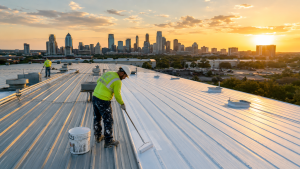
Commercial metal roof restoration is a full system treatment. It begins with thorough surface cleaning and primer application, moves through seam reinforcement using embedded fabric tape at every joint, and finishes with an elastomeric topcoat that bonds to the metal and flexes through thermal expansion and contraction cycles. Every step targets a specific failure mode. Skip one and you haven’t completed a restoration. You’ve applied a surface treatment that will fail at the same locations the original roof did.
Here’s why seams and fastener penetrations matter so much: thermal cycling works on every joint in a metal roofing system, repeatedly, across the entire life of the roof. Austin’s heat cycles put real stress on those connections. That constant movement gradually opens seams and works fasteners loose, often well before the panel face shows visible distress. Embedded fabric tape bridges each joint before any coating is applied, so the finished system isn’t just sealed at the surface. It’s reinforced at the exact points where water finds its way in.
Replacement removes everything and starts over. That’s the right call when the structure beneath the metal can no longer support a surface treatment. It isn’t the right call when the roof could have supported a well-executed restoration. Removing a structurally capable system because the assessment wasn’t thorough enough is a decision you can’t walk back.
When Does a Commercial Metal Roof Actually Need to Be Replaced?
Four conditions make replacement the right path. Outside of these four, restoration deserves serious evaluation before anything else gets committed to.
Deck or substrate compromise. If the decking beneath the metal panels shows rot, structural deflection, or rust-through, no surface treatment resolves that underlying problem. The deck has to be addressed, and that means opening the entire roof system.
Widespread panel section loss. Isolated panel damage is often addressable through targeted emergency repair work. When corrosion has consumed a significant portion of the panel field, a coating system has nothing structurally sound to bond to. Restoration economics stopped making sense at that point.
Fastener pullout failure. When fasteners are pulling through the panel face because the surrounding metal has fatigued past a functional threshold, the system has lost its structural connection. Applying a coating over that condition covers the failure without correcting it. The problem comes back.
Drainage design problems that can’t be corrected within the existing footprint. Standing water accelerates every failure mode in a metal roofing system. If slope and drainage can’t be fixed within the current layout, a full commercial roof replacement with a redesigned drainage configuration is the only durable solution.
Outside those conditions, restoration is typically the stronger path. Not just because of upfront cost, but because replacing a structurally capable roof closes off options that didn’t need to be closed.
How Do You Match the Right Solution to What’s Actually on Your Roof?
This is where the decision either gets made correctly or gets made by default. The table below connects common roof conditions to what typically happens when a decision is delayed versus when a thorough assessment drives the call.
| Roof Condition | Waiting or Patch-Only Approach | Acting With a Full Assessment From Armadillo Metal Roofing |
|---|---|---|
| Isolated leak, panels intact | Temporary relief only; root cause goes unaddressed and returns | Correct repair scope identified and completed right the first time |
| Multiple seam failures, deck sound | Recurring leaks; interior damage compounds with each weather event | Restoration addresses actual failure points across the full system |
| Surface corrosion, no section loss | Corrosion accelerates without intervention; restoration window closes | Restoration with proper prep extends system service life |
| Deck compromise or structural deflection | Any surface treatment fails prematurely over bad substrate | Replacement scoped correctly, no budget wasted on the wrong fix |
| Ponding water, drainage not correctable | Moisture damage compounds with every rain event | Replacement designed with corrected drainage from the ground up |
| End-of-life system, deck still sound | Risk of sudden failure grows; emergency repairs cost more under pressure | Options evaluated in writing with honest tradeoffs before a crisis forces the call |
What this table makes visible is that waiting carries a real cost. Every month a roof goes without a proper assessment, the available solutions narrow. What qualifies for restoration today may not qualify after the next Central Texas hail event.
What Does a Thorough Commercial Roof Assessment Actually Look Like?
Consider a situation that comes up regularly across the Austin area. A standing seam roof has been in service for several decades. There are active leaks at the ridge cap and visible corrosion at several panel laps. The deck appears structurally solid. Fasteners are holding. The panel face has oxidized significantly.
This is an illustrative scenario, not a specific documented case, but the diagnostic challenge it presents is real and recurs on commercial properties throughout Central Texas.
The most important call in that situation is whether the oxidation represents surface corrosion or actual section loss. Those are two different conditions with two different solutions. You typically can’t distinguish them from the ground or from a photograph.
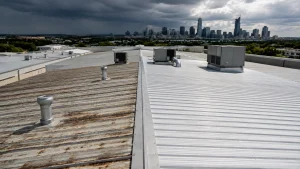
Surface oxidation changes the appearance of the metal and can look alarming from a distance. Section loss means the metal itself has thinned to the point where a coating system may not have anything structurally sound to bond to. When oxidation is present but section loss isn’t, and the deck is sound, restoration is likely the right path. Taking that roof down would mean disposing of a structurally capable system at full replacement cost for a problem the existing structure could have handled. That’s exactly the kind of call that gets made when an assessment isn’t thorough enough.
Armadillo Metal Roofing begins each project with an on-site inspection covering the roof surface, seams, fasteners, flashings, and penetrations, along with a deck condition evaluation where accessible. Findings come back in writing before any work is proposed, so you’re making a real decision based on real information. That process is what allows a genuine evaluation of the full range of metal roofing services for your building rather than defaulting to the first recommendation on the table.
One detail worth knowing: Armadillo Metal Roofing offers up to three solutions per client. When you receive multiple options with honest tradeoffs attached to each, you’re getting a genuine assessment. When you receive one option with no explanation of alternatives, you’re getting a sales call dressed up as an inspection.
What Are the Real Limitations of Restoration?
Restoration doesn’t work on every roof.
If the existing metal has lost a significant section to corrosion, an elastomeric coating may have nothing structurally sound to bond to. No surface preparation process changes that reality. When that’s what the inspection turns up, a properly scoped commercial metal roof replacement is the right call, and reaching that conclusion sooner protects your budget from going toward the wrong fix.
Restoration also doesn’t correct design problems built into the original installation. If the roof was constructed with inadequate slope, improper flashing terminations, or drainage that reliably pools water at low points, a coating system treats the surface while the underlying design flaw stays in place. The leaks come back through a different path.
And if a building’s use has changed in ways that significantly increase interior humidity or thermal load, the roofing system may need to be reconsidered at a design level rather than simply resurfaced.
The goal of every Armadillo Metal Roofing inspection is to recommend the right path for the specific roof being evaluated, not the most profitable path for the contractor.
When Is the Right Time to Make This Decision?
Most commercial property owners wait until there’s visible interior damage before they take the roof seriously. By that point, the roof has typically been failing at the seam or fastener level for some time. The water stain on the ceiling tile isn’t where the problem started. It’s where the problem eventually showed up.
Don’t let a ceiling tile be your early warning system.
The right time to get an assessment is before a weather event forces your hand. In Central Texas, that window matters. Severe storms across the Austin area can turn a manageable roof condition into an emergency metal roof repair situation within hours, and restoration eligibility can close just as fast. Armadillo Metal Roofing is available 24/7 for exactly that reason.
Mark Franz brings 18 years of direct commercial metal roofing experience to every assessment. Before founding Armadillo Metal Roofing, he spent 20 years as a Facilities Manager for Fortune 500 corporations. He understands what property owners and facility managers need from a contractor because he spent two decades on their side of the table. That background shapes how every inspection gets conducted and how findings get communicated. Armadillo Metal Roofing is fully licensed, insured, and bonded, holds a 5/5 rating on Google, and has served commercial property owners across Austin and the greater Central Texas area for 20 years.
Frequently Asked Questions
How do I know if my commercial metal roof qualifies for restoration?
The key variables are deck condition, panel section integrity, and fastener performance. If the substrate is structurally sound and corrosion hasn’t consumed the panel face, restoration is worth evaluating seriously. Visual signs from inside the building can’t tell you what’s happening at the seam and panel level, so an on-site inspection is the only reliable way to make that determination.
How long does a properly executed restoration last?
That depends on the coating system used, the quality of surface preparation, and local climate conditions. In Central Texas, UV exposure and thermal cycling are significant factors. The quality of seam reinforcement and primer adhesion is what separates a durable outcome from a short-lived one. Surface preparation is not the step to cut corners on.
Is restoration a real long-term solution or just a way to delay the inevitable?
It’s a real solution when it’s applied to the right roof. If a properly restored roof performs well for years on a building you plan to hold, operate, sell, or refinance in that window, that’s a materially different financial outcome than replacing a roof at full cost when the structure didn’t require it.
What’s the difference between a coating and a full restoration system?
A coating alone is a surface treatment. A full restoration system includes surface preparation, seam reinforcement with embedded fabric tape, primer, and an elastomeric topcoat. The seam reinforcement is the component that actually addresses how metal roofs fail. A coating applied without it will fail at the same seam points regardless of the coating material, because water gets in at joints before it gets in anywhere else.
Can storm damage to a commercial metal roof be covered by insurance?
That depends on the damage type and your specific policy. Hail and wind damage to metal panels is commonly addressed under commercial property policies. Armadillo Metal Roofing provides insurance claim assistance as part of its service process, so you’re not navigating that alone.
How should I evaluate a contractor’s recommendation when I’m not a roofing expert?
Ask how many options they’re presenting and why each one fits your specific roof. A contractor who delivers one recommendation hasn’t done a real assessment. A thorough assessment explains at least two or three paths, with the conditions and tradeoffs for each laid out clearly. If you can’t get a straight answer to “why is this the right option for my specific roof,” get a second opinion before committing to anything.
What should I expect from a commercial roof assessment in the Austin area?
A thorough assessment covers the roof surface, seams, fasteners, flashings, and penetrations, along with the deck condition where accessible. The inspector should ask about the building’s use, leak history, and any prior repairs. You should receive written findings that distinguish between what’s actively failing, what’s at risk, and what the options are, all before any work is proposed. That’s the standard every Armadillo Metal Roofing inspection is held to.
About the Author
Mark Franz is the owner and founder of Armadillo Metal Roofing. Before launching the company, he spent 20 years as a Facilities Manager for Fortune 500 corporations, which means he understands what property owners and facility managers actually need from a roofing contractor because he spent two decades on their side of the table. A lifelong Austin resident of 46 years and a University of Texas finance graduate, Mark brings 18 years of direct commercial metal roofing experience and provides personal oversight on every project the company takes on.