The roof over your facility is one of the largest capital expenses you’ll face, and the pressure to make the right call, fast, is real. Getting it wrong in either direction costs you: replace too soon and you’ve spent money you didn’t need to; restore when you should have replaced and you’re back on the phone six months later.
Armadillo Metal Roofing has worked with commercial property owners and facility managers across the Austin area for 20 years, and the replacement-vs-restoration question comes up on nearly every job. Here’s the honest answer.
Direct Answer
Commercial metal roof restoration is the right call when the structural substrate is sound, active leaks are isolated, and the coating or membrane has failed rather than the metal itself. Full replacement becomes necessary when panels show widespread corrosion, structural deflection, or repeated failures across multiple zones. Most commercial metal roofs in the Austin area qualify for restoration, not replacement, saving 40 to 60 percent of replacement cost when caught at the right stage.
Key Takeaways
- Restoration works when metal substrate integrity is intact; replacement is required when corrosion has compromised the structural panel
- A proper moisture survey (infrared or nuclear) is the only reliable way to distinguish surface deterioration from substrate failure
- Waiting on a “minor” leak is the most expensive decision you can make, because water migration under metal panels accelerates corrosion exponentially
- Austin’s heat cycling and hail exposure create a specific failure pattern that differs from northern climates, requiring local diagnostic experience
- Armadillo Metal Roofing offers 24/7 emergency response and instant online estimates, so you don’t have to wait to know where you stand
Why Do So Many Commercial Roofs Get Replaced When They Didn’t Have To?
The roofing industry has a financial incentive problem. Full replacement generates three to four times the revenue of a restoration project. That’s not a criticism of every contractor, but it is a structural reality that shapes what recommendations you receive.
The result: property owners in Austin are routinely told their roof is “beyond repair” when a qualified restoration would have extended service life by 10 to 15 years at a fraction of the cost. The decision gets made based on a visual inspection and a sales conversation, not a documented moisture assessment.
The single most important diagnostic step in the replacement-vs-restoration decision is a moisture survey, and most property owners never get one.
A moisture survey uses infrared thermography or nuclear isotope scanning to detect trapped moisture beneath the roof membrane. Wet insulation that doesn’t show up visually will cause ongoing corrosion and insulation failure if left under a new coating. That’s why restoration fails prematurely on some roofs: the underlying problem wasn’t diagnosed before the fix was applied.
If a contractor recommends replacement without performing or commissioning a moisture survey, that’s the moment to ask why.
What Actually Causes Commercial Metal Roofs to Fail in Austin?
Austin’s climate creates a failure pattern that’s worth understanding before you make any decisions.
The combination of intense UV exposure, summer heat that regularly pushes surface temperatures above 160°F, and sudden severe hail events puts a specific kind of stress on metal roofing systems. Thermal cycling, the repeated expansion and contraction of metal panels through daily and seasonal temperature swings, works fasteners loose over time and creates micro-gaps at seams and penetrations. That’s where water gets in.
Once water is under the panel, the problem accelerates. Trapped moisture combined with Austin’s heat creates an environment where corrosion moves faster than it would in a cooler, drier climate. A small seam failure in spring can become a compromised substrate by the following summer if it’s not addressed.
The practical implication: the window between “restorable” and “needs replacement” is shorter in Central Texas than in most other markets. Acting on a known leak or visible coating failure within one season is not overcautious. It’s the economically rational move.
Waiting feels safe. It’s actually the most expensive decision on the table.
The Restoration-vs-Replacement Decision Framework (The Substrate Integrity Test)
The Substrate Integrity Test is a four-factor diagnostic framework for determining whether a commercial metal roof qualifies for restoration or requires replacement.
Use it as a starting point before any contractor conversation.
Factor 1: Panel Corrosion Depth. Surface rust is a coating failure. Pitting or perforation that reaches through the metal panel is a substrate failure. Surface rust is restorable. Perforated panels require section replacement at minimum, full replacement if widespread.
Factor 2: Moisture Survey Results. Less than 25 percent wet insulation across the roof area is generally restorable. Above 25 percent, the economics shift toward replacement because saturated insulation must be removed regardless, and the labor cost of doing that approaches replacement cost anyway.
Factor 3: Fastener and Seam Integrity. Isolated fastener failures are repairable. Systemic fastener pull-through across multiple zones indicates the substrate has lost holding strength, which is a replacement indicator.
Factor 4: Number of Previous Repairs. A roof that has been patched in the same zones more than twice is telling you something. Repeated localized failures in the same area mean the underlying condition hasn’t been resolved, and another patch won’t change that.
Use this framework when: you’re in the early assessment stage and want to enter a contractor conversation with informed questions.
Don’t use it as a substitute for: a professional moisture survey and structural assessment by a qualified commercial metal roofing contractor.
What Does a Realistic Restoration Project Actually Look Like?
Consider a common scenario: a 40,000-square-foot distribution facility in the Austin metro with a standing seam metal roof showing active leaks at three penetrations, visible coating oxidation across the south-facing slope, and no prior moisture survey on record.
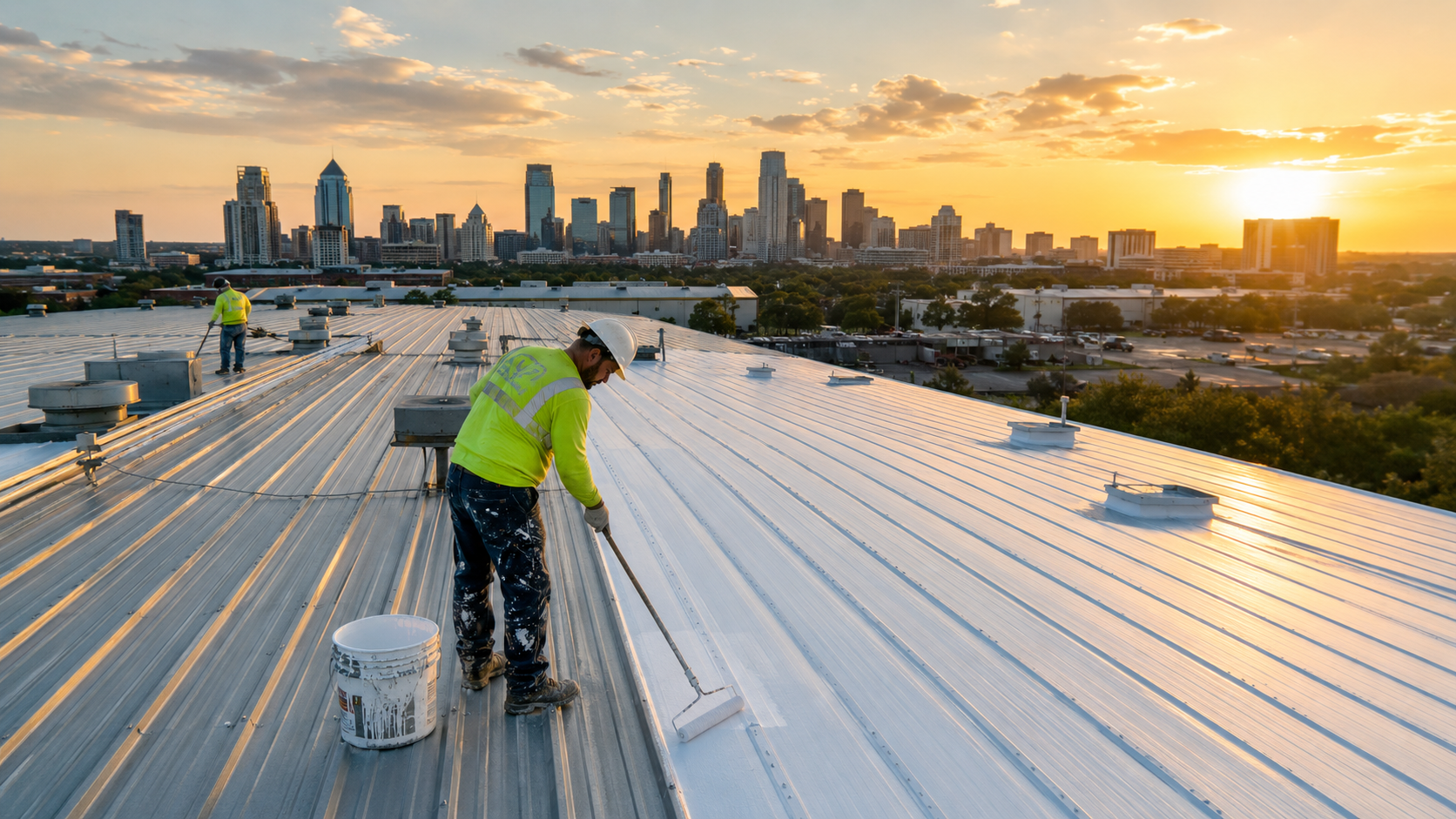
A qualified assessment would include an infrared moisture scan, fastener pull-test sampling, and seam inspection at the leak points. If the substrate comes back clean and wet insulation is under 20 percent, the property qualifies for a full restoration: clean and prep the surface, address the penetration failures, apply an elastomeric coating system rated for 10-plus years, and document everything for the insurance file.
Timeline for a project that size: typically two to four weeks depending on weather windows and material lead times.
The cost difference between that restoration and a full tear-off replacement on the same building is substantial. Restoration on a qualifying roof runs roughly 40 to 60 percent less than replacement. That’s not a marketing claim; it’s the math of labor and materials when you’re not removing and disposing of the existing roof system.
If you’re managing a facility in that situation right now, getting an estimate in front of you is the right next step. Armadillo Metal Roofing provides instant online estimates, so you can see real numbers without waiting for a sales appointment.
Restoration vs. Replacement: What You’re Actually Choosing Between
| Decision Factor | Restoration (Qualifying Roof) | Full Replacement | Doing Nothing |
| Upfront cost | 40-60% less than replacement | Highest upfront investment | Zero now |
| Service life added | 10-15 years with proper coating | 30-40 years (new system) | Months to 1-2 years |
| Business disruption | Minimal, phased work possible | Moderate, full tear-off | None until failure |
| Insurance documentation | Restoration creates repair record | New system resets the clock | No documentation, claim complications |
| Risk if wrong call | Shorter-than-expected coating life | Unnecessary spend | Structural damage, interior loss, liability |
| Austin climate suitability | High, if substrate is sound | Always appropriate | Accelerates failure timeline |
The comparison that matters isn’t restoration vs. replacement. It’s acting now vs. waiting until the decision gets made for you by a failed roof.
Who Should Think Carefully Before Choosing Restoration?
Restoration isn’t the right answer for every roof. Here’s where the honest conversation has to happen.
If your building is being sold within 12 to 18 months and the buyer’s inspector will be looking at the roof, a restoration that extends life 10 years may serve you better than replacement. But if the roof has multiple zones of structural compromise, perforated panels, or a moisture survey showing widespread saturation, restoration is throwing money at a problem that’s past the point of surface treatment.
Armadillo Metal Roofing will tell you which situation you’re in. If your roof genuinely needs full replacement, that’s what we’ll recommend, because a restoration that fails in two years doesn’t serve anyone. The 20-year reputation we’ve built in Austin depends on honest assessments, not on selling the higher-ticket job.
The goal is work done right the first time, and that starts with the right diagnosis.
Ready to Know Where Your Roof Actually Stands?
If you’ve been putting off the assessment because you’re not sure what you’re walking into, that’s the exact moment to call. Armadillo Metal Roofing offers 24/7 availability for emergency situations and instant online estimates for planned assessments. You’ll know what you’re dealing with before you commit to anything.
Contact Armadillo Metal Roofing to schedule your commercial roof assessment. Austin’s commercial roofing specialists are ready when you are.
Frequently Asked Questions
How do I know if my commercial roof qualifies for restoration without calling a contractor first?
Look for three things you can observe yourself: widespread surface oxidation or chalking on the coating (surface issue, often restorable), active leaks that are isolated to penetrations or seams rather than spread across the field of the roof (restorable), and no visible panel deflection or sagging between supports (structural integrity intact). If you’re seeing sagging, widespread rust through the panel surface, or leaks in multiple unrelated zones, you’re likely past restoration territory and need a professional assessment quickly.
What happens if I restore a roof that actually needed replacement?
The coating will fail prematurely, typically within two to five years instead of the expected ten to fifteen, because the underlying substrate or saturated insulation continues to degrade beneath the new coating. You’ll have spent restoration money and still face replacement costs. This is why a moisture survey before any restoration work is non-negotiable, not an upsell.
Does my commercial property insurance cover restoration, or only replacement?
Most commercial property policies cover damage repair, which can include restoration work when the damage is documented and the restoration addresses the covered cause of loss. The key is documentation: a professional assessment report, a moisture survey, and a detailed scope of work. Armadillo Metal Roofing assists with insurance claims and can help you build the documentation file your adjuster needs.
How long does a commercial metal roof restoration actually last in Austin’s climate?
A properly applied elastomeric coating system on a qualifying substrate typically carries a 10 to 15 year service life in Central Texas conditions. The range depends on coating thickness, surface preparation quality, and whether penetrations and seams were properly addressed before coating. Roofs that skip surface prep or apply coating over wet insulation see significantly shorter performance.
What’s the difference between a roof repair and a roof restoration?
A repair is targeted: you fix the specific failure point, a seam, a penetration, a fastener. A restoration is a system-level intervention: the entire roof surface is cleaned, primed, and recoated to reset the weatherproofing layer across the whole field. Repairs address symptoms; restoration addresses the condition of the whole roof. If you’ve repaired the same area more than twice, you’re past the repair stage.
Can a commercial metal roof be restored in summer heat in Austin?
Yes, with proper scheduling. Most elastomeric coating systems have application temperature windows, and experienced crews work early morning hours during peak summer to stay within those windows. The bigger issue in summer is surface temperature at time of application, not air temperature. Armadillo Metal Roofing has worked Austin summers for 20 years and schedules around these conditions as standard practice.
What should I ask a roofing contractor before agreeing to a full replacement quote?
Ask these four questions: Have you performed or commissioned a moisture survey? Can you show me the specific areas of structural compromise that disqualify restoration? What percentage of the roof area is affected? And what’s the cost comparison between restoration and replacement for this specific roof? A contractor who can’t answer all four clearly, with documentation, hasn’t done the diagnostic work to justify a replacement recommendation.
If your facility is in Austin, Round Rock, Cedar Park, Georgetown, Kyle, Buda, Pflugerville, San Marcos, or anywhere in the surrounding area, Armadillo Metal Roofing serves your market. Get your assessment scheduled before the next weather event makes the decision for you.
About the Author
Armadillo Metal Roofing is a commercial metal roofing specialist serving Austin, TX and the surrounding Central Texas area. With 20 years of local operating experience, they provide commercial metal roof repair, restoration, replacement, and installation services, including 24/7 emergency response and insurance claim assistance. They work with facility managers, commercial property owners, and project managers who need reliable, professional work done right the first time.