Your commercial roof is leaking, your tenants are calling, and you’re staring at a situation with no obvious next step. The pressure isn’t just the damage itself – it’s not knowing whether you’re looking at a repair, a restoration, a full replacement, or an insurance claim, and every hour of indecision is another hour of exposure.
Direct Answer
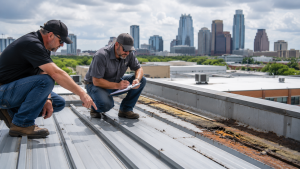
When a commercial metal roof is damaged, the fastest path forward is a professional damage assessment that separates what’s repairable from what’s beyond repair, followed by a written scope of work and a parallel insurance claim review if the damage has a weather or event cause. Most Austin commercial property owners can have a clear action plan within 24 to 48 hours of that first call.
Key Takeaways
- Get a written damage assessment before making any repair or restoration decision – verbal estimates leave you exposed during insurance negotiations.
- Repair, restoration, and replacement are not interchangeable options; each applies to a specific condition threshold on your roof system.
- Insurance claims require documentation that starts at the moment of damage, not weeks later when you finally call.
- A contractor who has been maintaining your roof is 55% more likely to be hired for replacement work – the relationship pays off in both directions (Clear Seas Research, 2007).
- Waiting to act on visible damage almost always increases the total cost; water infiltration compounds faster than most facility managers expect.
What’s Actually Making This Decision So Hard?
The real problem isn’t the damage. It’s that you’re being asked to make a financial decision with incomplete information, under time pressure, in a technical domain you don’t manage every day.
You can see water stains on the ceiling. You might have photos from the last hailstorm. What you don’t have is a clear answer to the question that actually drives the decision: is this roof worth saving, or is it time to replace it?
That question has a specific, answerable answer. But most property owners never get it framed clearly because the first contractor they call either jumps straight to replacement (higher ticket) or patches the obvious leak without assessing the underlying condition. Neither approach gives you what you need to decide well.
The decision you’re trying to make isn’t “who do I call” – it’s “what am I actually dealing with.” Get that answered first, and the rest of the process becomes straightforward.
Why Does This Confusion Keep Repeating Itself?
Here’s the root cause: commercial roofing decisions are structurally different from residential ones, but most property owners apply residential logic to them.
On a house, you either fix the leak or you replace the roof. On a commercial metal roof, there’s a third option – restoration – that sits between repair and replacement and is often the right call for roofs with widespread but not catastrophic damage. Restoration involves applying a coating system or membrane over the existing roof to extend its service life by 10 to 20 years, at roughly 50 to 70 percent of replacement cost.
Most property owners don’t know that option exists until someone explains it. And if the first contractor you call doesn’t offer restoration, they won’t mention it.
A survey by Clear Seas Research found that 76% of commercial property decision makers are suspicious of roofing providers that focus on single technologies. That instinct is correct. A contractor who only does replacement will find reasons to replace. A contractor who offers repair, restoration, and replacement can actually match the solution to the condition.
The Three-Stage Triage Framework for Commercial Roof Decisions
The Three-Stage Triage Framework is a structured decision process that matches your roof’s current condition to the appropriate response category before any money is committed.
Stage 1: Damage Classification
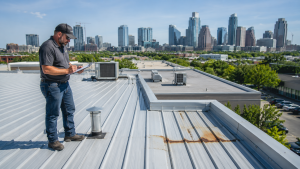
Not all damage is equal. Surface-level damage – minor punctures, sealant failures, flashing separations – is typically repairable without touching the underlying system. Widespread panel corrosion, persistent ponding, or structural compromise signals a different category entirely.
A common scenario: a facility manager calls after a hailstorm, assuming the roof needs full replacement because there’s visible denting across multiple sections. A proper assessment reveals the metal panels are structurally sound, the coating has failed in localized areas, and a restoration coating system will restore full weather resistance at a fraction of replacement cost. The damage looked catastrophic. It wasn’t.
Stage 2: Insurance Eligibility Review
If the damage has a weather or sudden-event cause, you may be looking at a covered claim before you’re looking at an out-of-pocket expense. This step happens in parallel with the damage assessment, not after it.
The documentation window matters. Insurance adjusters work from evidence, and evidence degrades. Photos taken the day after a storm carry far more weight than photos taken three weeks later after additional weathering. If you suspect a covered event, start documenting immediately – date-stamped photos, written notes, weather event records.
Stage 3: Scope and Timeline Decision
Once you know what you’re dealing with and whether insurance applies, the scope of work becomes a straightforward document: what gets done, in what order, at what cost, by when. This is where you evaluate contractor options, not before.
Skipping to Stage 3 without completing Stages 1 and 2 is how property owners end up overpaying, under-claiming, or making irreversible decisions with incomplete information.
If you’re currently somewhere in Stage 1 or Stage 2 and need a professional eye on the situation, Armadillo Metal Roofing offers assessments for commercial properties across the Austin area. Getting a written scope before you commit to anything is the right move.
What Does a Realistic Outcome Actually Look Like?
Honest answer: it depends on what Stage 1 reveals. Here’s a realistic picture of each path.
| Scenario | Typical Scope | Realistic Timeline | Insurance Likely? |
| Isolated leak, minor flashing failure | Targeted repair, sealant work | 1 to 3 days | Rarely, unless storm-caused |
| Hail or wind event, surface damage | Restoration coating or panel repair | 1 to 3 weeks | Often yes, document immediately |
| Widespread corrosion, aging system | Full restoration or replacement | 3 to 8 weeks | Depends on cause and policy |
| Active leak, structural risk | Emergency repair + full assessment | Same day to 48 hours | Depends on cause |
| New construction or full replacement | New metal roof installation | 4 to 10 weeks | N/A (new build) |
Armadillo Metal Roofing handles all five of these scenarios for commercial properties in Austin and the surrounding area, including 24/7 emergency response for active damage situations. The 20 years of local operating history means the team has seen every variation of Central Texas weather damage – hail, wind, flooding, and the thermal cycling that puts stress on metal roofs through Austin’s hot summers.
The one thing that’s true across every scenario: waiting makes every category worse. Water infiltration doesn’t pause while you decide. A small leak becomes a substrate problem. A substrate problem becomes a structural one.
Who This Approach Is Built For (and When It Matters Most)
This framework applies most directly when you’re managing a commercial property with a metal roof and you’re facing one of three situations: visible or suspected damage, an upcoming insurance claim, or a roof that’s aging and you’re not sure whether to repair or plan for replacement.
If you’re a facility manager responsible for multiple properties, the triage process is worth running on every roof in your portfolio, not just the one currently showing symptoms. Scheduled maintenance is used in less than half of all commercial properties surveyed (Clear Seas Research, 2007), which means most facility managers are operating reactively. The ones who aren’t are spending less per square foot over time.
If you’re a property owner planning new construction, the decision framework is simpler: specify metal roofing from the start, choose a contractor with commercial installation experience, and build a maintenance relationship from day one. That relationship matters. Research shows that 55% of commercial property owners are more likely to hire the contractor who has been doing their repairs when replacement time comes (Clear Seas Research, 2007). Starting that relationship early protects your long-term options.
The most expensive roofing decision you’ll make isn’t the replacement. It’s the deferred repair that made replacement unavoidable.
What This Process Doesn’t Solve
Straight talk: a damage assessment and triage process gives you clarity on your roof’s condition and your options. It doesn’t guarantee insurance approval. Claim outcomes depend on your policy terms, the adjuster’s findings, and the documentation you’ve preserved.
Armadillo Metal Roofing assists with insurance claims and can help you document damage properly, but no contractor can guarantee a claim outcome. What documentation and professional assessment do is give you the strongest possible position going in.
The triage framework also doesn’t apply to roofs that are clearly and structurally beyond repair. If a roof has reached that point, the decision is already made – the only question is timeline and scope of replacement. Armadillo Metal Roofing handles those projects too, but the framework is designed for situations where the right path isn’t yet obvious.
When you’re ready to stop guessing and get a written assessment of what your roof actually needs, call Armadillo Metal Roofing. We serve commercial properties across Austin and within 100 miles of the city center, and we’re available around the clock for situations that can’t wait.
FAQ
How do I know if my commercial roof damage is covered by insurance?
Coverage depends on your policy and the cause of damage. Storm events, hail, and wind damage are commonly covered under commercial property policies, but coverage requires documentation and a timely claim. The best first step is to document the damage with photos immediately and contact a contractor who can provide a written assessment to support your claim.
What’s the difference between roof restoration and roof replacement for a commercial metal roof?
Restoration means applying a coating system or membrane over your existing roof to restore its weather resistance and extend its service life, typically by 10 to 20 years. Replacement means removing the existing system and installing a new one. Restoration costs significantly less but only applies when the underlying structure is still sound. A professional assessment tells you which category your roof falls into.
How fast can Armadillo Metal Roofing respond to an emergency repair situation?
Armadillo Metal Roofing offers 24/7 availability for emergency commercial roof repairs in Austin and the surrounding area. Active leaks and storm damage situations can typically be assessed and stabilized within 24 to 48 hours, depending on the scope and site conditions.
Should I get multiple bids before committing to a commercial roofing contractor?
Getting more than one opinion on scope and pricing is reasonable, especially for large projects. What matters more than the number of bids is the quality of the assessment behind each one. A bid based on a thorough written inspection is worth more than three bids based on a quick visual walkthrough. Ask every contractor to specify exactly what they’re proposing and why.
Can I wait until the damage gets worse before deciding what to do?
Waiting almost always increases total cost. Water infiltration that starts as a surface problem works its way into insulation, substrate, and eventually structural components. What’s repairable today may require full replacement in six months. The decision to wait feels financially cautious but typically isn’t.
How do I document roof damage for an insurance claim?
Start with date-stamped photos taken as close to the damage event as possible, covering the full roof surface and any interior evidence of infiltration. Note the weather event, date, and any visible impact points. A written assessment from a licensed roofing contractor strengthens your claim significantly. Don’t wait for the adjuster to schedule a visit before you start documenting.
Does Armadillo Metal Roofing handle both repairs and full replacements, or just one?
Armadillo Metal Roofing handles the full range: emergency repairs, restoration coatings, and complete commercial metal roof replacement and new installation. The recommendation you get is based on your roof’s actual condition, not on which service generates a larger job.
When the situation is unclear and the stakes are real, get a professional assessment before you commit to anything. Armadillo Metal Roofing has been serving commercial properties across Austin and Central Texas for 20 years. Request your estimate online or call us directly – we’re available whenever you need us.
About the Author
Armadillo Metal Roofing is a commercial metal roofing specialist based in Austin, TX, providing repair, restoration, replacement, and new installation services across the greater Austin area. With 20 years of local operating history, they work with facility managers, commercial property owners, and project managers to protect their buildings with professional, reliable roofing solutions. Owner Mark provides direct oversight on projects, and the company is available 24/7 for emergency response.