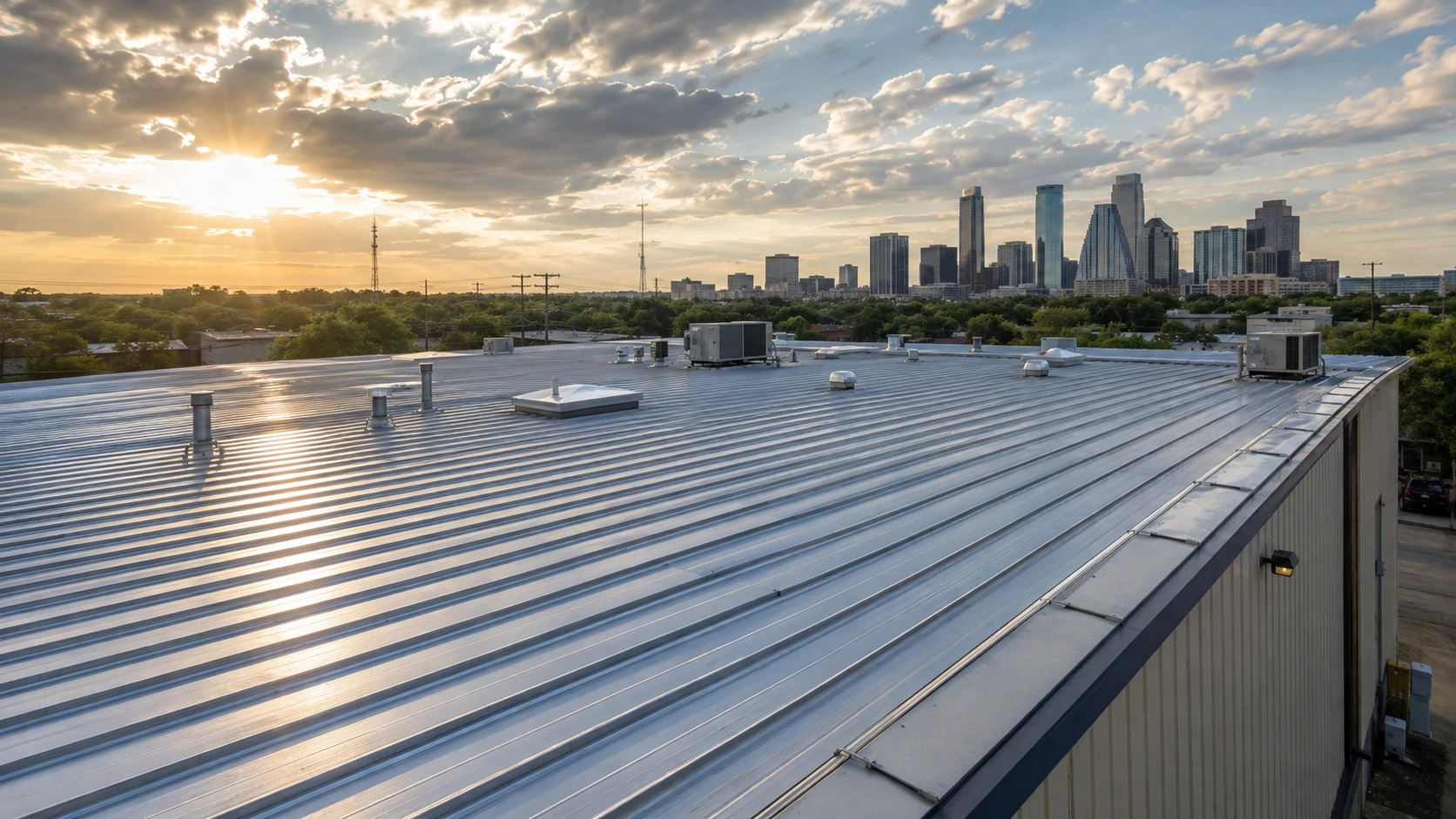
When a commercial metal roof shows signs of trouble, three paths sit in front of you: repair the specific damage, restore the aging system with a fluid-applied coating, or replace the whole thing. The right answer comes from what a physical inspection actually finds, not from what a contractor decided before climbing on the roof.
Key Takeaways
- Repair addresses localized damage on a structurally sound system, but it doesn’t slow the underlying aging of the roof.
- Restoration is often the right call when the substrate is solid but the surface is failing, and it typically costs significantly less than full replacement.
- Replacement is the correct path when structural compromise or widespread panel failure is beyond what a surface treatment can resolve.
- A contractor who shows up with one recommendation already in mind is running a sales call, not an assessment.
- Waiting on a known problem isn’t a neutral choice: water intrusion compounds, and options that exist today may not exist after another season.
Why Do So Many Properties End Up With the Wrong Scope of Work?
Because the recommendation often gets made before the inspection is finished.
When a contractor arrives with a preferred answer already in hand, you’re not getting a genuine assessment of your building. You’re getting a pitch. A roof that looks like a clear replacement candidate from the parking lot might turn out to be an excellent restoration candidate once someone actually walks it and checks the substrate. A roof that seems to need a few patches might have fastener pull-through distributed across a wide section of field panels. You can’t see either of those things from the ground.
The inspection is where the real decision gets made. Without one, every recommendation is a guess. And guessing on a commercial roof in Austin means either spending money you didn’t need to spend, or deferring a problem that gets harder to solve every time it rains.
Armadillo Metal Roofing starts each project with an on-site inspection to evaluate the existing roof, identify actual performance issues, and determine which path fits the building’s condition, budget, and long-term goals. Based on what that assessment turns up, the team recommends the solution that genuinely fits, not the one that’s simplest to present. Depending on the situation, that assessment may surface multiple viable options worth weighing.
What Does Repair Actually Cover?
Targeted commercial metal roof repair is the right scope when damage is specific and well-defined. A failed flashing section. A panel with hail impact damage. A sealant joint that’s let go. A cluster of fasteners that have backed out and are letting water migrate into the building below. The work is defined by what’s actually failing, and nothing more.
Repair makes the most sense when the damage is confined to a clearly identified area rather than scattered across the field, when the panels and substrate surrounding that area are sound, and when the roof hasn’t been logging repeat leak events in the same locations year after year.
Consider a situation where a summer storm damages a contained section of a standing seam roof that’s otherwise performing well and has real service life remaining. Targeted repair addresses the problem, protects the building interior, and stops the damage from spreading into something more expensive. That’s the scenario where repair is clearly the right call.
There’s a limitation worth naming directly: repair doesn’t address the aging of the roof system. If patches keep going into the same spots on a cycle of twelve or eighteen months, that’s no longer a repair situation. The cumulative cost of ongoing patch work tends to approach the cost of a full restoration anyway, but without delivering the service life extension that a proper restoration provides. At some point, the patch-and-wait approach becomes the most expensive option on the table, not the most conservative one.
For situations where a failure can’t wait, emergency metal roof repair is available around the clock. A roof leak doesn’t follow business hours, and neither do we.
What Is Restoration, and Why Does It Get Overlooked?
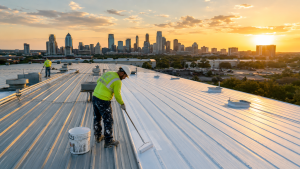
Commercial metal roof restoration is the application of a fluid-applied membrane or coating system over an existing metal roof. It seals fastener penetrations, bridges minor panel separations, and creates a continuous weatherproof barrier across the entire surface without removing the underlying panels.
This is the option that tends to get underexplained or skipped over entirely. It doesn’t look like a dramatic solution. But it’s often the correct one.
Here’s what that means in practical terms. Full tear-off and replacement on a large commercial roof is a capital project with real disruption attached to it: dumpsters in the parking lot, extended timelines, tear-off activity that affects tenants and daily operations. Restoration on that same roof, when the substrate is structurally sound, avoids all of that. You also avoid the substantial cost difference between a surface-applied system and a full replacement. For a property manager or facilities director trying to keep a building running, that distinction matters.
There’s also a thermal performance angle that’s particularly relevant in Central Texas. Restoration coatings with high solar reflectance ratings reduce the heat transferred through the roof into the building. A dark metal roof that absorbs heat through the hottest part of the year behaves meaningfully differently once a properly applied reflective coating is in place. That’s not a minor detail in the Austin climate.
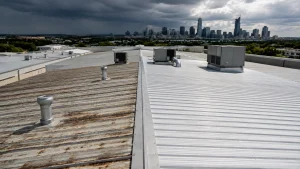
To illustrate how this plays out in practice: consider a 15-year-old R-panel commercial roof showing surface rust, a handful of fastener backouts, and two active leak points at the ridge cap, while the structural framing underneath remains solid. In that situation, restoration is the option worth taking seriously. It addresses the surface failures, seals the penetrations, and can add warranted service life, all without the cost and disruption of a full replacement. That’s not a compromise position. For that building’s actual condition, that’s the right call.
Restoration doesn’t work on every roof. If the structural framing or decking has been compromised by water intrusion, a coating applied over the top doesn’t fix what’s happening below the surface. The substrate has to be sound first. That’s exactly why the inspection happens before the recommendation, not after.
When Is Replacement the Honest Answer?
Replacement is the right path when the existing system genuinely can’t support a restoration, or when getting it to that point would cost as much as starting over.
Conditions that point toward replacement include structural framing or decking compromised by long-term water intrusion, panel deformation severe enough that a surface system can’t restore weatherproofing, fastener pull-through distributed broadly across the field rather than isolated to a defined area, or a roof that has already been through a restoration and is at the end of that system’s warranted life.
Replacement isn’t a failure. Sometimes it’s simply the correct one. But it should be the answer because a real inspection says so, not because a contractor walked in with one option and that happened to be it.
When replacement is the right scope, installation quality determines everything that follows. Commercial metal roof replacement on a commercial building is a significant project, and work done right the first time is the only version that delivers the service life the system is built for. You can review what commercial metal roof installation involves for new and replacement projects to understand what a properly executed job looks like from start to finish.
Acting Now Versus Waiting: What the Choice Actually Costs
Most property owners frame this as “which option fits my roof?” The more accurate frame is “act on what the inspection shows now, or deal with what the roof becomes after another season of unaddressed water intrusion.”
| Decision Factor | Acting on the Inspection Finding | Waiting Without a Proper Assessment |
|---|---|---|
| Substrate condition | Addressed while viable options still exist | Continues to deteriorate; choices narrow |
| Restoration eligibility | Preserved if substrate is currently sound | Lost once structural compromise develops |
| Project scope and cost | Based on the roof’s real, current condition | Increases as water intrusion compounds the damage |
| Business disruption | Planned and controlled | Forced and unplanned, typically more disruptive |
| Insurance claim window | Open when storm damage is documented promptly | May close before it’s used |
| Who controls the timeline | You, with real information | The roof, on its own schedule |
Water intrusion doesn’t pause while a decision gets deferred. A minor leak at a fastener penetration can saturate insulation, accelerate rust from inside the panel, and eventually compromise the structural deck below. A building that’s a straightforward restoration candidate today becomes a replacement project after one or two seasons of unaddressed intrusion. Waiting feels like a neutral choice. The roof treats it as an active one.
What Should You Do If You’re Not Sure Where Your Roof Stands?
Get an inspection from a contractor who’ll show you what the assessment actually found, and what the real options are.
Armadillo Metal Roofing has been serving commercial properties across the Austin area for 20 years, holds a 5/5 Google rating, and is fully licensed, insured, and bonded. Mark Franz founded the company after 20 years as a facilities manager for Fortune 500 corporations, and he brings 18 years of hands-on commercial metal roofing experience to every project. He’s been on both sides of this conversation: as the person authorizing the work, and as the person doing it. That background is why the inspection process here is built to produce a genuine assessment, not a recommendation that was already decided before anyone got on the roof.
Estimates are available 24/7. If you’re managing a property anywhere in the greater Central Texas area and you’re not certain what your roof actually needs, the full range of metal roofing services is a good starting point before you commit to any scope of work.
Frequently Asked Questions
How do I know whether my commercial metal roof needs repair, restoration, or replacement?
You can’t know without a physical inspection. Surface rust, active leaks, and visible panel damage are symptoms, not diagnoses. The variables that actually determine the right path are substrate condition and how widely the damage is distributed across the system. Neither is visible from the ground. Get a qualified contractor on the roof before committing to any scope of work.
Is metal roof restoration as durable as a new roof?
A properly applied restoration system on a sound substrate adds real service life and typically comes with a manufacturer warranty. It’s not identical to a new roof, but it’s not a temporary patch either. The condition that makes it work is a structurally sound substrate. If the underlying panels or framing are compromised by water intrusion, a coating applied over the top won’t address what’s happening below the surface. Restoration works when the structure is solid and the surface is where the problems are.
What’s the cost difference between restoration and replacement in Austin?
Restoration on a structurally sound roof generally runs at a significantly lower cost than full tear-off and replacement on the same building. The actual numbers depend on roof size, panel type, the coating system specified, and existing surface condition. Those variables matter enough that a general range is only useful for early budgeting conversations. A real number for your specific building requires an actual inspection.
Can I just keep repairing instead of committing to restoration or replacement?
Up to a point, yes. But repeated repairs on an aging roof are symptom management, not a maintenance strategy. When the same areas keep failing on a recurring cycle, the cumulative cost of ongoing patch work tends to approach restoration cost anyway, without delivering the service life extension a full restoration provides. At some point, continuing to repair becomes the most expensive option on the table, not the most conservative one.
Does commercial metal roof restoration qualify for insurance coverage?
It depends on the cause of the damage. If deterioration stems from a covered weather event, your policy may cover restoration work. Age-related wear typically doesn’t qualify under most commercial policies. Armadillo Metal Roofing assists with insurance claims as part of the service process, so you’re not navigating that alone. A documented inspection report is usually the starting point for any weather-related claim.
How long does a commercial metal roof restoration take?
For most commercial buildings in the Austin area, a restoration project runs from a few days to roughly two weeks, depending on roof size, the coating system specified, and weather conditions during application. That’s substantially faster than a full replacement and generally doesn’t require the building to be vacated. Work schedules can usually be coordinated around normal business operations.
What happens if I wait another season before addressing my roof?
The roof doesn’t wait with you. A minor leak at a fastener penetration can saturate insulation, accelerate rust from the inside, and eventually compromise the structural deck beneath the panels. A building that’s a solid restoration candidate today can become a replacement project after one or two seasons of unaddressed water intrusion. Waiting feels like a neutral choice. The roof treats it as an active one.
About the Author
Mark Franz is the owner of Armadillo Metal Roofing and a native Austinite with 46 years of roots in this city. He holds a Finance degree from the University of Texas and brings 18 years of hands-on commercial metal roofing experience to every project. Before founding Armadillo Metal Roofing, he spent 20 years as a facilities manager for Fortune 500 corporations, giving him a direct understanding of how property owners and facility managers actually think about roofing decisions. He founded Armadillo Metal Roofing to give commercial property owners across Central Texas honest assessments and durable solutions built for this climate.