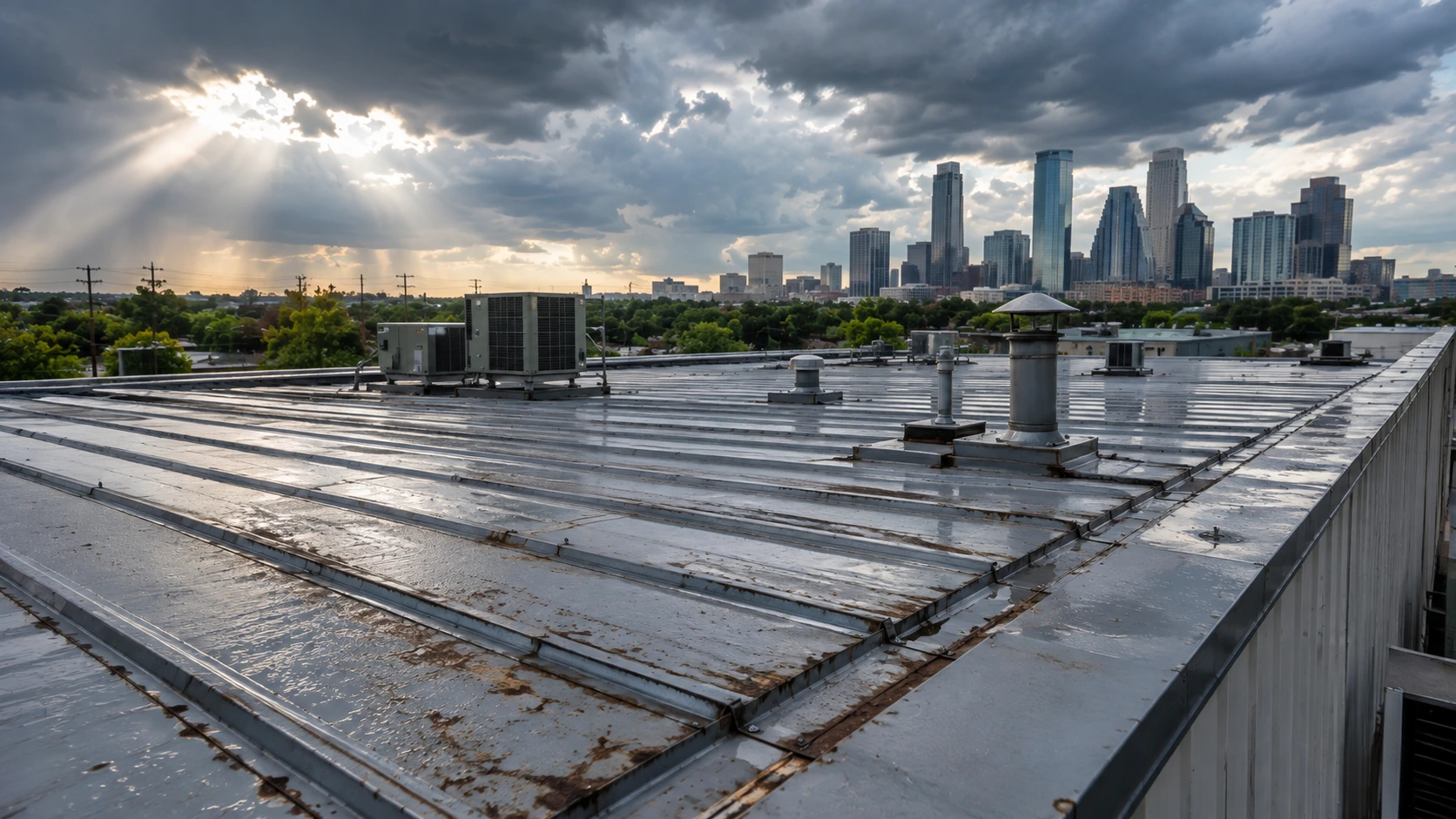
When water enters a commercial building, the instinct is to stop it fast. That’s the right instinct. But stopping a leak and understanding what produced it are two different things. The real question isn’t how bad the leak is. It’s how much of the roof system is still performing, and whether the failure you’re looking at is a single point or the beginning of a pattern.
Key Takeaways
- Active water intrusion calls for emergency repair, but sealing one entry point doesn’t tell you anything about the condition of the system that produced it.
- Restoration is the right path when the metal substrate is structurally sound but coatings, seams, and fasteners have degraded.
- Replacement is warranted when corrosion has penetrated the metal substrate in multiple locations or the structural deck has taken on moisture damage.
- Repeated repairs on the same section are a signal of system-level failure, not bad luck with weather.
- A complete assessment covers deck condition, fastener integrity, and coating state together, not just the location where water came in.
What Is the Roof Actually Telling You?
Most commercial metal roof failures don’t originate in a storm. They develop because coatings break down across multiple seasons, fasteners back out incrementally year after year, and seams that were never fully sealed at original installation eventually give way under thermal movement and weather stress.
The storm just makes it visible.
By the time water enters a building, the roof system has typically been underperforming for a while. That timeline matters because it determines which solution actually addresses the problem versus which one only buys time. Emergency repair addresses the entry point.
Restoration or replacement addresses the system.
A single on-site inspection that evaluates deck condition, fastener integrity, and coating state together is what separates a repair call from a restoration project from a full replacement decision. None of those paths can be chosen responsibly from a photograph or a phone call.
When Does Emergency Repair Make Sense?
Emergency metal roof repair is the right first move when water is actively entering your building and you need to stop the damage now. A failed seam after a hail event, a fastener that’s backed out and left an open penetration, flashing that’s separated at an HVAC curb. These are discrete, locatable failures with a clear fix.
What emergency repair isn’t is a long-term answer for a roof that’s reached systemic degradation.
Consider a situation that’s common across Central Texas facilities. A facility manager calls after a severe thunderstorm. Water is coming in near the ridge. A crew seals the open seam and the building goes dry. Six months later, two more seams opened in different sections. That pattern isn’t a mechanical failure responding to one weather event. It’s a system breaking down, and each new leak is a data point pointing toward the same conclusion.
Emergency repair fits when the failure is isolated, the surrounding substrate is sound, and you need to protect interior assets while a full assessment gets scheduled. When those conditions don’t hold, repair is a temporary measure. Treating it as a resolution just delays the outcome your building actually needs.
When Is Commercial Metal Roof Restoration the Right Call?
Commercial metal roof restoration involves cleaning the existing surface, addressing fasteners and seams, and applying a fluid-applied coating system that restores waterproofing performance across the full roof area.
Here’s why it works mechanically. Fluid-applied coatings bond directly to the metal substrate and form a continuous membrane over the entire surface, including fastener heads and seams. Those are the two most common failure points on standing seam and corrugated metal systems. The coating doesn’t just cover the surface. It addresses the specific vulnerabilities that produce leaks in the first place.
The financial case is real. Restoration avoids tear-off and disposal costs entirely, and it extends the service life of a roof system that still has usable substrate underneath it. On the accounting side, how a restoration project is classified as a maintenance expense or a capital expenditure depends on your specific situation, jurisdiction, and accounting method. Your CPA or financial advisor is the right person to confirm that for your books, but it’s a question worth asking before your next budget cycle.
A roof that looks rough on the surface is often a stronger restoration candidate than it initially appears. Surface oxidation and coating failure look alarming, but they aren’t the same as structural failure. The condition of the deck and the integrity of the metal beneath the weathered surface are what actually determine whether restoration holds.
Restoration is the right call when metal panels are structurally sound, when fasteners are loosening or seams are opening but the deck beneath them is still dry, when the existing coating has chalked and cracked but the metal itself is intact, or when you’ve had two or more repairs on the same section within a few years. If you manage a commercial property in Austin with a metal roof that has a history of minor repairs, restoration may well be on the table. An on-site assessment is the only reliable way to confirm it, because the answer lives in deck condition and substrate integrity, not in what the surface looks like from the ground.
When Is Full Replacement Actually Necessary?
Commercial metal roof replacement is warranted in specific circumstances. A roof that looks rough or carries a repair history doesn’t automatically need to come off.
Replacement is the correct path when the metal substrate has corroded through in multiple locations, when the structural deck has sustained moisture damage affecting load capacity, or when the existing system is so far outside current code that restoration wouldn’t bring it into compliance.
One limitation worth stating directly: if you’ve been patching the same roof for years and the deck is showing moisture damage across multiple bays, restoration won’t change the outcome. Applying a coating system over a compromised deck places a waterproofing layer over a structural problem. That doesn’t hold. At that point, replacement is the right answer, and presenting any other path would be doing you a disservice.
When the situation calls for a new system, it’s worth taking the time to understand your options before committing to any contractor or product. The commercial metal roof installation process involves matching the right system to your building’s specific load requirements, drainage configuration, and long-term performance expectations. Getting that match right at the front end saves considerably more than it costs.
A Framework for Making the Call
Start with condition, not cost. Three questions move you from uncertainty to a defensible decision.
Is the deck compromised? If moisture has reached the structural deck and caused deterioration, no coating system will hold long-term. Restoration requires a sound substrate. Without it, replacement is the only responsible path forward.
Is the failure isolated or systemic? One failed seam after a hail strike is isolated. Three failed seams across different sections over two years is systemic. Isolated failures point toward repair. Systemic failures point toward restoration or replacement, depending on what the deck condition shows.
How much substrate life remains? A metal roof with usable life left in the substrate is a strong restoration candidate. A roof where the metal itself is corroding through in multiple locations has consumed that life, and restoration won’t recover it.
At Armadillo Metal Roofing, our process starts with inspection, moves to condition determination, and arrives at options from there. We present up to three solutions per client so the recommendation reflects the full range of what’s actually available to you, not just one path someone settled on before they got on your roof. A contractor who presents only one option hasn’t actually assessed your roof. You’ve received a pitch, not an assessment.
| Situation | Acting with Armadillo Metal Roofing | Waiting, Patching, or Skipping a Full Assessment |
|---|---|---|
| Active isolated leak | Stopped and documented; full system condition assessed so the next failure isn’t a surprise | Stopped for now; underlying cause unknown; next failure unanticipated |
| Systemic seam and fastener failure | Assessed; restoration plan or replacement path identified before the window closes | Patched again; degradation continues; restoration option may close entirely |
| Coating failure on a sound deck | Restoration scoped; service life extended at a fraction of replacement cost | Nothing done; deck exposure increases; problem converts to a replacement-sized project |
| Deck with moisture damage | Replacement scoped correctly; right system matched to building type and use | Deferred; structural risk compounds; emergency replacement forced under pressure at higher cost |
| Post-storm emergency | Repair completed 24/7; follow-up assessment scheduled before the next storm season | Building dried; no picture of system condition heading into future weather |
Why Austin’s Climate Compresses the Decision Window
Central Texas puts commercial metal roofs through conditions that compress the timeline most property owners expect based on manufacturer documentation.
Intense UV exposure, summer heat that routinely pushes well past 100 degrees, and severe convective storms with hail create a stress pattern that’s harder on roofing systems than what moderate climates produce. Thermal cycling is a factor that often gets underestimated. Metal expands and contracts through large daily temperature swings, and that movement works fasteners loose and stresses seams in ways that compound across seasons. By the time a fastener has backed out enough to allow water intrusion, it’s typically been cycling through two or three seasons already. The failure you’re seeing didn’t start last week.
This is why scheduling a full roof assessment after any emergency repair matters. Stopping one leak tells you where the system was weakest first. It doesn’t tell you where it’s weakest second or third.
Mark Franz has lived in Austin for 46 years and holds a finance degree from the University of Texas. He spent 20 years as a facilities manager for Fortune 500 corporations before founding Armadillo Metal Roofing, which gives him a firsthand understanding of how property owners and facility teams actually face these decisions from the building side of the table. With 18 years of direct experience in commercial metal roofing, his assessments are calibrated to what actually happens to metal roofs in this climate, not to warranty language written for a national average.
The Step Most People Skip After an Emergency
Getting the leak stopped is step one. What most facility managers and property owners don’t ask until they’re back in the same situation months later is what that repair revealed about the rest of the roof.
A single emergency repair is a data point. It shows where the system was weakest first. A qualified contractor uses that information to give you a real picture of overall roof condition, not just a report on the section that failed.
If you’ve had emergency work done and no one discussed what the surrounding roof looks like, you didn’t get a complete service. You got a patch.
Many commercial metal roof restoration projects across the greater Austin area start exactly this way. The repair stops the immediate problem. The follow-up assessment determines whether the building is heading toward restoration or replacement. Knowing which one before the next round of severe weather arrives is worth more than any individual patch.
Armadillo Metal Roofing holds a 5/5 rating on Google, is fully licensed, insured, and bonded, and has been serving commercial property owners across the greater Austin area for 20 years. The team is available 24/7 and evaluates every roof with an on-site inspection that looks at the full system, not just the leak point. To get a complete picture of what your commercial metal roofing system is actually telling you, start with an honest on-site assessment from a contractor who’s seen what this climate does to these roofs over the long run.
Frequently Asked Questions
How do I know whether my commercial metal roof needs repair, restoration, or full replacement?
The clearest signal is pattern. One repair after one weather event points toward a repair situation. Two or more repairs on the same section within a few years means the system is degrading, not just responding to isolated events. An on-site inspection that evaluates deck condition, fastener integrity, and coating state gives you a defensible answer rather than a judgment call made from the ground.
How long does commercial metal roof restoration extend the service life of a roof?
That depends on the quality of preparation work, the coating system selected, and local climate conditions. In Central Texas, where UV intensity and thermal cycling are aggressive, prep work and coating selection carry more weight than the warranty language on the product itself. A properly applied system on a sound substrate can meaningfully extend service life, but no honest contractor will give you a specific number without physically assessing your roof’s current condition.
Is commercial metal roof restoration less expensive than replacement?
In most cases, yes, substantially so. Restoration avoids tear-off and disposal costs entirely. Whether it also qualifies as a maintenance expense rather than a capital expenditure for your accounting purposes depends on your specific situation, so confirm that with your CPA. The exact cost comparison depends on roof size, condition, and system selection, which is why an on-site assessment is the useful starting point rather than a ballpark given over the phone.
What happens if I keep patching rather than restoring?
Each patch addresses one failure point while the rest of the system continues to degrade. You’re spending repair money repeatedly without stopping the underlying deterioration. At some point, the cumulative cost of those patches approaches what restoration would have cost, except by then the deck may have taken on moisture and the restoration window may have closed entirely. That converts a restoration-sized project into a replacement-sized one.
Can a commercial metal roof be restored if it has visible rust?
Surface oxidation doesn’t disqualify a roof from restoration. Rust that has corroded through the metal substrate in multiple locations is a different matter. The distinction requires a physical inspection, not a visual assessment from the ground or a photograph. A contractor who rules out restoration based on surface appearance alone, without checking the substrate underneath, hasn’t done the actual assessment.
How quickly can Armadillo Metal Roofing respond to an emergency repair call in Austin?
Armadillo Metal Roofing is available 24/7. For isolated failures such as an open seam, failed flashing, or a backed-out fastener, emergency repairs can be completed once a crew is on-site. The repair itself is the fast part. The follow-up assessment to understand overall roof condition takes more time, and it’s the part that actually protects you from the same situation repeating.
What should I ask a contractor before agreeing to a roof replacement?
Ask whether restoration was evaluated and specifically ruled out, and what ruled it out. Ask to see the deck condition findings that support the replacement recommendation. Ask what the expected service life of the proposed new system is and what the warranty actually covers. A contractor who can’t answer those questions clearly, or who never raised restoration as a possibility, hasn’t given you a real assessment of your options.
About the Author
Mark Franz is the owner of Armadillo Metal Roofing and brings 18 years of direct experience in commercial metal roofing to every project. Before founding Armadillo, he spent 20 years as a facilities manager for Fortune 500 corporations, giving him firsthand perspective on how property owners and facility teams actually navigate roofing decisions from the building side of the table. A lifelong Austin resident and University of Texas finance graduate, Mark built Armadillo Metal Roofing to give commercial property owners across the greater Austin area honest assessments and solutions built for long-term performance.
